

REVIEW · ANNAPURNA TREKS FROM KATHMANDU
20 Days Annapurna Circuit Trek
Thorong La makes the whole trip worth it. This 20-day Annapurna Circuit trek is built around the iconic Thorong La Pass (5,416m) and the smart breathing room you get with acclimatization in Manang. I also like how the route mirrors real Nepal life, from lower, greener days near Syange to colder, drier high country as you gain elevation. One consideration: the high-pass day starts early and the wind can be brutal, so you want to be ready for a physically demanding, cold-weather morning.
What makes it easier to manage is the support system. You get airport pickup and drop, Kathmandu sightseeing by car, and a licensed guide plus a porter on a set ratio of 2 guests per porter (25 kg max). I’ll add a small but important note for planning: drinks are not included, and the long travel links (like the drive back from Pokhara) can feel tiring after a full trekking stretch.
Key things you’ll notice right away

- Thorong La Pass timing: an early start so you can be on top before the cold wind hits.
- Manang acclimatization day: a full day in the village area instead of rushing straight through.
- The Kali Gandaki valley vibe: the route keeps returning you to wide, dramatic valley views.
- Sharp vegetation change: you’ll move from arid, dry stretches toward pine and conifer forests later on.
- Poon Hill sunrise option: a short extra push for early light over major Himalayan ranges.
- Clear included supports: licensed guide, porter support, permits, and most key meals.
Why the Annapurna Circuit feels like Nepal in chapters

The Annapurna Circuit is famous for a simple reason. You don’t just hike up a mountain. You travel through climate zones fast enough to feel like you are reading Nepal by elevation.
You begin in Kathmandu, then work your way out toward Syange, starting around the 823m mark. After that, the trek slowly ratchets up. By the time you reach Pisang (around 3,200m), you’re already in a colder world with big peak views. And once you’re in Manang, the scenery starts to look more high-altitude and less jungle, even if you’re still surrounded by villages.
Later, the tour plays with that “change happens” theme again. After dropping down toward the Kali Gandaki valley, you hit a stage where the vegetation shifts, going from dry, arid conditions into pine and conifer forests. That kind of contrast is one of the best parts of this trek, because it makes every day feel slightly new, even when you’re following the same general circuit idea.
You also get the cultural rhythm. The trip passes through places like Pisang and Manang where you can see how communities live at elevation. Then you come down into areas connected to sacred sites, especially as you reach Muktinath.
You can also read our reviews of more hiking tours in Kathmandu
Price and logistics: does $1,200 make sense?
At $1,200 per person for about 20 days, the big question is what you’re actually buying besides the trail itself. This package includes the core services that can be hard to coordinate on your own: a government-licensed trekking guide, a porter (with a defined maximum load), and key official permits.
Here’s what stands out as value:
- Permits included: ACAP (Annapurna Conservation Area Project) permit and a TIMS card. These are often the annoying parts that slow down DIY planning.
- Support built in: guide and porter, with a clear rule that porters carry up to 25 kg, and the group ratio is set.
- Transport links covered: Kathmandu to Besisahar by regular bus, then Besisahar to Syange by sharing jeep, plus return transport to Kathmandu and airport transfer.
- Meals partially included: breakfast is listed for 18 days, dinner for 15 days, and lunch for 15 days. Drinks are not included, so you should plan for that extra daily cost.
What’s not included, and matters for your budget:
- Visa and international flight are on you.
- Drinks are not included.
- Temple entrance fees in Kathmandu are not included (for example, Pashupatinath, Boudhanath Stupa, and Kathmandu Durbar Square are listed as not included).
- Tips, plus rescue and evacuation costs, plus “any other special accommodation” are also not included.
So should you think “cheap” or “pricey”? I’d call it fair, because it’s paying for the licensed guiding structure, permits, and the transport chain. If you are the type who wants everything lined up and doesn’t want to spend evenings managing permits, schedules, and logistics, the value is pretty easy to see.
Kathmandu warm-up: Pashupatinath, Boudhanath, and Durbar Square
You start with Kathmandu, and that’s not just a formality. You get two days to reset your body and your sense of place before trekking.
Day 1 is built around getting you to a hotel after you land at Tribhuvan Airport, with a representative meeting you outside the airport terminal. If you’ve ever arrived in a new country with jet lag and no plan, you’ll understand why this matters.
Day 2 is a classic Kathmandu trio:
- Pashupatinath Temple on the Bagmati river, the biggest and most popular Hindu temple in the world, with Lord Shiva as the main focus.
- Boudhanath Stupa, a UNESCO World Heritage site and a major Buddhist symbol, known for its peaceful and distinctive presence.
- Kathmandu Durbar Square, tied to the old royal seats of Kathmandu and Patan.
These stops are excellent for two reasons. First, they give you cultural context for what you’ll keep seeing in villages while trekking. Second, they help you adjust to local traffic and altitude-adjacent air after landing, without jumping straight onto steep climbs.
From Kathmandu to Syange: the slow start that sets your pace
The trip builds a gradual handoff from city to trail. After your Kathmandu sightseeing day, you travel out toward the trekking region.
You’ll take a scenic drive and cover a long day of moving through foothills. You’re aiming for Syange, around 823m, for overnight. Syange is where your “trek brain” starts to turn on. The next day is where the actual climbing begins.
Then comes the first trekking push to Dharapani, with scenery like gorge views, high hills, and waterfalls described along the route. Even if you don’t think of Day 4 as “training,” it’s a good reality check. The trail starts steep for a half hour before you settle into farm terraces and a more agricultural rhythm.
Practical note: early days like this are where you decide your system for pacing. Keep your effort steady. Don’t force speed. You’re building endurance for the real work later.
Chame and Pisang: switching elevation, switching feel

After Dharapani, the trek goes toward Chame. This section is where the air gets cooler and the vegetation starts to shift. You transition through forested sections before reaching village life in Chame.
Then you go to Pisang at about 3,200m. This day usually feels like a steady climb rather than a wild roller coaster. You’ll trek along the north bank side of the river for part of the walk, which helps the day feel varied, even when the gradient is consistent.
Why this matters: by the time you reach Pisang, you’re not only climbing. You’re also getting your first sustained taste of how mountain weather works. Clouds can change fast. Light can turn harsh. You’ll be glad you packed for layers.
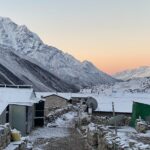
Manang acclimatization day: don’t skip it in real life

One reason this trek works is the built-in acclimatization day in Manang. You spend a full day here exploring the village area, described as home to about 500 flat-roofed houses, set in dramatic surroundings.
This is the kind of “seems like a free day” moment that is actually strategic. Acclimatization is about letting your body adjust before you push higher. And in practical terms, it gives you time to settle into your hiking pace, check your gear, and make sure you’re comfortable in colder conditions.
You don’t just pass through Manang. You’re given a reason to be there.
Yak Kharka and the Thorong High Camp approach

After Manang, the route heads to Yak Kharka. The description of this stage emphasizes a slow climb with inspiring views of peaks like Annapurna II, Gangapurna, Tilicho, and Chuli.
Then you move to the Thorong High Camp View Point, with the route described as a slow climb to the last settlement of Ledar. This is your approach phase, where your walking effort starts to feel more “thin-air serious,” even if you’re not yet crossing the pass.
A good way to think about this stage: it’s a test run for the mindset you’ll need on Day 11. You’re learning how to walk steadily when your body feels like it’s working harder for the same distance.
Crossing Thorong La Pass (5,416m): the day you plan for

This is the headline day for the whole circuit.
You start early after breakfast so you can reach the top before the cold wind begins to blow. That timing detail is not trivia. On high passes, wind and visibility can change the entire feel of the climb. The tour plan explicitly tries to manage that.
The climb can be strenuous at the start, and the route is described as steep in the beginning. The key goal is reaching Thorong La Pass at 5,416m, then descending onward.
After the pass, the descent leads you to the sacred village of Muktinath at about 3,800m. This day is called the longest in terms of trekking, which makes sense because it includes both a major elevation gain component and a serious descent.
If you’re prone to rushing when you feel excited, try not to. A calmer pace early on helps you save energy for the descent, where you still need good control under fatigue.
Muktinath to Marpha: Kali Gandaki valley and the long drop
After reaching Muktinath, the trek continues with a major descent toward the river valley floor of the Kaligandaki. The plan describes a drop of around 1,200m to the Marpha area.
There’s also a stop at Ekale Bhatti, described as a lonely teahouse settlement. Even without over-romanticizing it, this kind of stop is practical. When you’ve been high, your body appreciates a rhythm of breaks and food even if the scenery is the main event.
Then you reach Marpha, a village stop that sets you up for the next walk along the river.
Lete and Tatopani: arid to forest, Dhaulagiri to Annapurna framing
From Marpha, the walk is described as enjoyable, following the Kali Gandaki downstream toward Tukuche village, with the route continuing to Lete.
You also get a moment where the trek passes beneath Tukuche peak and Dhaulagiri, which matters because it gives you a clear sense of scale. Big peaks look different when you’re close enough to feel like they’re standing right over the valley.
Next comes Tatopani, and this section is memorable for the vegetation shift. The route starts in dry, arid conditions and transitions into pine and conifer forests. It’s also described as passing between the two giant peaks of Dhaulagiri and Annapurna.
If you like when a hike changes character mid-route, this is one of those stages.
Ghorepani and Poon Hill: the short sunrise push
After Tatopani, you head to Ghorepani (about 2,860m). The trek includes crossing a suspension bridge over the Kali Gandaki river, which adds a “structure” moment to the walk and breaks up the monotony that sometimes creeps in after many days.
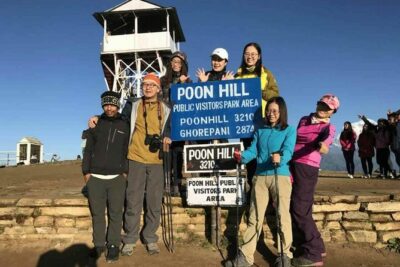
Then comes Poon Hill. You take a one-hour hike when weather permits, aiming for sunrise. The view spans a panorama range that includes Dhaulagiri, Annapurna, and the Mt. Manaslu range.
This is a great contrast to Thorong La. It’s still high and still serious, but it’s a shorter effort with a clear reward. If sunrise is your thing, do it. If you’re the type who hates early starts, this might be your one “choose wisely” day.
Then you continue toward Tikhedhunga and onward.
Pokhara: lakes, walking away from altitude, and recharging
You finish trekking into Pokhara after passing through rural farm villages and areas with views of nearby waterfalls described along the route.
Pokhara is your real recovery window. You also get a full leisure day in Pokhara with options around lakes:
- Phewa Lake
- Begnas Lake
- Rupa Lake
This is not a requirement to be active. It’s where you let your legs soften back into normal life and where you can enjoy Nepal without the constant “how high am I now?” feeling.
Then, the next day, you travel back to Kathmandu by bus, taking a scenic route passing Trisuli and Marsyangdi River areas. It’s another long day of sitting, so plan to use it as downtime rather than sightseeing.
Who this trek fits best, and who should think twice
This experience is aimed at people with at least moderate physical fitness. That’s the right wording, because the itinerary includes daily trekking blocks plus a major pass day.
You’ll probably enjoy it most if:
- you want a classic high-altitude adventure with cultural stops
- you like steady structure (acclimatization day, clear stages)
- you prefer having permits and guiding handled
You might want to think twice if:
- the idea of a cold, early start for the pass feels like your biggest nightmare
- you know you struggle with long travel days after trekking days
- you expect the package to include everything related to lodging and daily spending, because drinks and many extra items are listed as not included
Should you book this Annapurna Circuit trek?
I’d book it if you want the Annapurna Circuit in a clean, guided format where your hardest work is the trekking, not the planning. The mix of Manang acclimatization, a well-timed Thorong La Pass attempt, and the added payoff of Poon Hill sunrise gives you multiple “big moments” without making the itinerary feel random.
I wouldn’t book it if you want total freedom to design your own route, or if you’re trying to keep costs extremely low by doing zero planning. Also, if your tolerance for early mornings and wind-driven cold is low, be honest with yourself about whether you’re truly ready for the pass day.
FAQ
How long is the Annapurna Circuit trek on this trip?
The trek is planned for about 20 days.
Where does the trip start and when?
It starts at the Great Adventure Treks & Expedition Pvt. Ltd meeting point in Kathmandu, with a start time of 8:15am.
What is the price per person?
The price is listed as $1,200.00 per person.
Is this a private tour?
Yes. It’s listed as private, and only your group will participate.
What trekking support is included?
An professional trekking guide with a government license is included, along with a porter. The porter is planned as 2 guests per porter, with a maximum of 25 kg.
Are permits included?
Yes. The itinerary includes the Annapurna Conservation Area Project Permit (ACAP) and a TIMS card.
Are meals included?
Breakfast is included for 18 days, dinner for 15 days, and lunch for 15 days. Drinks are not included.
Are temple entry fees included in Kathmandu sightseeing?
No. Entry fees for Pashupatinath Temple, Boudhanath Stupa, and Kathmandu Durbar Square are listed as not included.
More Hiking & Trekking Tours in Kathmandu
More Tour Reviews in Kathmandu
Not for you? Here's more nearby things to do in Kathmandu we have reviewed


Annapurna Treks from Kathmandu, compared.
 ★ 5.0Annapurna Circuit Trek with Tilicho LakeFrom $1,093368 reviews
 ★ 5.0Annapurna base camp trek 5 DaysFrom $699252 reviews
 ★ 5.0Annapurna Base Camp TrekFrom $935111 reviews
 ★ 5.0Kathmandu to Annapurna Base Camp (ABC) 5-Day TrekFrom $99102 reviews
 ★ 5.0Annapurna Circuit TrekFrom $1,17594 reviews
 ★ 5.04 Days Poon Hill TrekFrom $40594 reviews
 ★ 5.0Annapurna Base Camp Trek 12 DaysFrom $80085 reviews
Annapurna Base Camp TrekFrom $78581 reviews
★ 5.0Annapurna Base Camp Trek 12 DaysFrom $80085 reviews
Annapurna Base Camp TrekFrom $78581 reviews
Browse the lists this tour appears in