

REVIEW · HELICOPTER TOURS
Everest Base Camp Tour & View Point by Helicopter from Katmandu
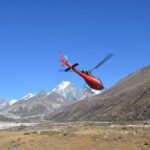
Everest looks different from the air. This Everest Base Camp helicopter tour whisks you from Kathmandu to high viewpoints like Kalapatthar (5,545m) and gives you aerial views of glaciers and the Khumbu Region.
I love the way the route squeezes in big-name sights without trekking for days. I also like the small-group setup, up to 5 passengers with a pilot, which makes it feel more focused than a big bus-and-queue operation.
One thing to weigh: the day depends on weather, and at higher altitude there’s a practical limit on how many people can be taken to the Everest Base Camp section and Kalapatthar (maximum 3). That means your exact landing experience can vary within the group.
Key highlights you can bank on

- Kalapatthar landing at 5,545m, with classic Everest angles that are hard to beat from the ground
- Everest Base Camp and Kalapatthar flyovers, so you get the layout even if you cannot stay there long
- A fuel-and-route plan that includes Lukla, with short stops built into the flight timing
- Syangboche landing at Everest View Hotel, where an optional breakfast pairs the view with a pause on the ground
- Small group flight (max 5 passengers), which tends to mean fewer moving parts in the cockpit
The big idea: Everest Base Camp without the trek grind

If your body is tired, your schedule is tight, or you just want the cleanest possible “Everest day,” this is the kind of option that makes sense. Instead of hiking up to thin-air elevations over many days, you go fast, with a big chunk of the experience happening in the sky.
You get the famous names, Kalapatthar and Everest Base Camp, plus the surrounding glacier maze and Khumbu geography from above. And the flight time is substantial enough that it does not feel like a quick photo hop.
To be clear, this is not the same as walking the trails. But if what you want is close-up views of Everest and the sense of place around the Khumbu, the helicopter version can be a very efficient way to do it.
A few more Kathmandu tours and experiences worth a look

Kathmandu starting point and the early-morning reality
The tour starts at TIA Domestic Terminal parking lot in Kathmandu, with a start time of 6:15 am. Hotel pickup and drop-off are included, so you do not need to figure out domestic transport that early.
A 6:15 am start is early, but it fits the pattern for flights that have to work with weather and daylight. In the Himalaya, conditions can turn quickly, and this kind of day needs a buffer.
The total duration is listed at about 3 hours 55 minutes, with about 3 hours of flight time. That makes it short enough to plan around, but long enough to feel like you actually did the experience, not just looked at it.
Route walk-through: from Kathmandu to Lukla to the high points

Here’s how the flight day is structured, and why it matters.
You launch from Kathmandu’s domestic terminal and fly on a Eurocopter 350 B3 model helicopter. The first stop is Lukla, described as a fuel drop for the return trip to Kathmandu. This short stop is not a sightseeing break, it’s logistics so the aircraft can keep flying.
From there, you continue toward the Pheriche – Dughlha Road area for a split of the group. The operator notes that due to thin air, the maximum number of passengers taken to the Everest Base Camp section and Kalapatthar is 3. In plain terms: the day is designed around altitude limits and safe operating capacity.
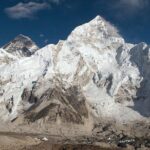
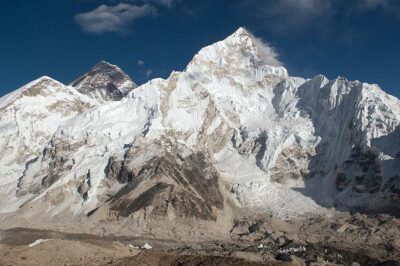
Then comes the main view segment, where you fly over Kala Patthar (5,545m) and Everest Base Camp (5,364m). The flight includes the kind of looping coverage that gives you a better sense of scale than a single straight pass.
Finally, you land at Everest View Hotel in Syangboche (3,870m). Breakfast there is optional, but even if you skip it, the point is that you get a stretch on the ground with panoramic views.
Why Kalapatthar at 5,545m is such a big deal

Kalapatthar is listed at 5,545 meters, and that elevation is the reason it’s a classic Everest-view target. From that height, the geometry of Everest shifts: you can see more of the ridge lines and the way the valleys stack behind it.
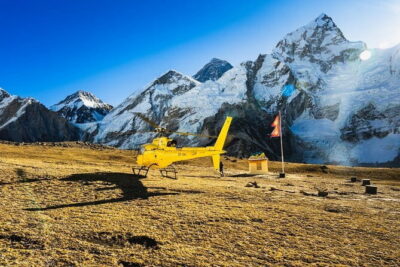
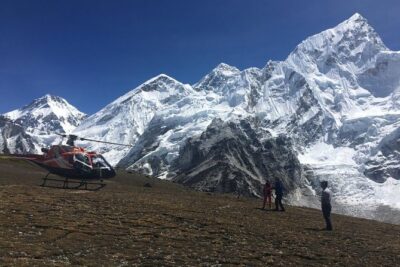
This tour is designed to give you that close-up angle by including a landing at Kala Patthar. That matters more than people expect. A landing means you are not only looking past the window, you’re also giving yourself a chance to orient visually.
Two other details make it more than a simple fly-by:
- You are flying the segment as part of a plan that includes Everest Base Camp coverage too, not just one point.
- The flight timing aims to keep you in view of the high scenery long enough to make it feel complete.
If you are choosing between this and a helicopter option that never lands anywhere, landing at Kala Patthar is a major quality difference.
Everest Base Camp from the air: what you gain
This experience includes flyovers of Everest Base Camp along with Kala Patthar. From the ground, Everest Base Camp is all about the details, the trail connections, and the weathered structure of the camp area. From the air, you trade those close-in details for something else.
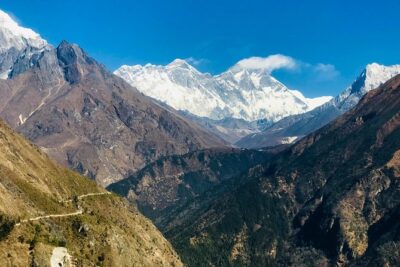
From above, you can see the shape of the terrain: the glacier patterns, the route geometry, and where Base Camp sits in relation to the higher ridges you’re also looking at. You end up with a map-like understanding of the Khumbu Region that trekking often builds more slowly.
It’s also useful for travelers who want Everest but cannot manage a longer altitude progression. Instead of spending multiple days climbing toward 5,000m plus, you see the destination while your body is under a much less prolonged strain.
One caution: from a helicopter, you still depend on visibility. Clouds and haze can cut contrast, so bring expectations that the view quality will ride with the weather.

The Pheriche split: how altitude limits shape your day

The tour specifically notes that at Pheriche, the group is split because of thin air. It also states that the maximum number of passengers taken to the Everest Base Camp section and Kalapatthar is 3.
What does that mean for you in practice? It means your experience can vary slightly depending on how the operator routes passengers within the small group. Some people may get closer exposure to the high-segment landings, while others may get the same high-altitude sights through the flight pattern.
The good news is that the group size is capped at five passengers. When you are not in a crowd, this kind of routing is easier to manage and it tends to feel fair.
If you are the type who needs maximum certainty about exactly where you step on the ground, this is the one part to clarify when you book.
Syangboche and Everest View Hotel: the pause that makes it feel real

A standout part of this itinerary is the landing at Everest View Hotel in Syangboche (3,870m). That land stop turns the day from only “look through a window” into a more complete circuit.
The tour states that breakfast is optional, but the reason to consider it is simple: you get a panoramic view while you’re standing still. In a helicopter day, movement is constant, so having time to take it in matters.
Also, being at 3,870m is still high, but it’s a different kind of experience than racing through the highest elevations. You can use the stop to catch your breath, hydrate, and reset mentally before the return flight segments.
This is the part of the day that can feel most like a “moment,” even if everything is happening quickly.
Price and value: is $1,800 worth it?
The price is $1,800 per person, and it’s helpful to separate what’s covered from what’s not.
Included:
- Everest helicopter flight in group sharing (5 passengers and a pilot)
- Hotel pickup and drop-off
- Fuel surcharge
Not included:
- Optional breakfast at Everest View Hotel
- Travel insurance and emergency evacuation cost
- Everest National Park Permit & Municipality fee
- Airport tax
So what are you paying for? In a nutshell, you’re paying for speed, access, and a tightly managed high-altitude sightseeing loop. If you were to do this the trekking way, you’d be trading money for time, physical preparation, and multiple nights in the region.
Is $1,800 a bargain? No. But it can feel like strong value when you look at:
- the flight time and coverage of major Everest viewpoints
- the small-group nature
- the fact that landing at Kala Patthar and a hotel stop in Syangboche are part of the experience design
Where the budget can get tricky is the items not included. Permits, municipality fees, and airport tax are listed as excluded. If you do not factor them in early, the real total can surprise you.
If you want the best value for the price, plan for weather flexibility too, because this tour needs good conditions.
Weather and comfort: the practical reality of flying at altitude
This experience requires good weather. If it’s canceled due to poor weather, you are offered a different date or a full refund.
That’s important because it frames the whole day. Even if everything is booked and ready, clouds can win. If your Nepal schedule is tight with little flexibility, you might need to think twice or build in cushion days.
Also check the physical limit: the tour lists total weight per passenger: 176 lbs. If you are above that threshold, you may not be able to join this specific option.
Inside the reality of a small helicopter group, the best attitude is to be ready for fast changes. You cannot control wind, visibility, or cloud movement. What you can do is show up early, follow instructions, and keep your expectations flexible.
Who this tour fits best
This helicopter circuit is a strong match if you:
- want close-up Everest views without trekking for days
- have a tight schedule in Nepal, or you want to save energy for other sightseeing
- prefer a small group rather than a large crowd experience
- care about seeing multiple Everest landmarks, Kalapatthar and Everest Base Camp, even if the Base Camp time is from the air rather than on foot
It might be less satisfying if you’re chasing the slower, walking-based immersion of the Everest region. If you want long trail days, village time, and camp routines, a trek route will feel more aligned.
Planning support that matters more than you think
One thing I’d highlight from the way this experience is organized: support and communication can make or break a high-altitude day. In this case, the tour operator is Himalayan Mentor, and a guide named Kesh is mentioned as proactive with planning and pre-communication, especially around logistics and preparation.
That kind of clarity is not fluff. For tours that rely on altitude, weather, and routing, you want answers early: what to expect, what to prepare, and how the day is supposed to run.
If you are the kind of person who likes to know the timeline, ask questions before you go. In particular, ask how the Pheriche split might affect your landings if you want specific viewpoints on the ground.
Should you book this helicopter Everest Base Camp and Kalapatthar tour?
Book it if you want the most direct, high-impact Everest day available from Kathmandu. The combination of Kalapatthar landing, Everest Base Camp and Khumbu views from the air, and a Syangboche stop at Everest View Hotel makes this feel like a full sightseeing loop, not a short detour.
Hold off if:
- you cannot move your schedule in case of weather delays
- you are expecting a trek-like experience on the ground
- you cannot meet the listed 176 lbs weight limit
- you want everything included in the base price, because permits, municipality fee, airport tax, and optional breakfast are excluded
If you do decide to book, I’d treat it like a serious flight day, not a casual excursion. Arrive on time, pack warm layers for altitude temperature swings, and keep your plans flexible.
Done right, this is one of those rare travel days where Everest is not just a distant idea. It’s the thing you are actually looking at, in a way that feels immediate and real.
FAQ
What is the total duration of the Everest Base Camp helicopter tour from Kathmandu?
The tour is listed at approximately 3 hours 55 minutes total, with about 3 hours of flight time.
What time does the tour start and where do we meet?
The start time is 6:15 am. You meet at the TIA Domestic Terminal parking lot in Kathmandu (44600), and the tour ends back at the meeting point.
How many people are in the helicopter?
The flight is described as group sharing with a maximum of 5 travelers, including a pilot.
Does the tour include landing at Kala Patthar and at Everest View Hotel?
Yes. The itinerary states a landing at Kala Patthar (5,545m). It also states you land at Everest View Hotel in Syangboche, with an optional opportunity for breakfast there.
What is included in the $1,800 price?
Included are the Everest helicopter flight (group sharing with 5 passengers and a pilot), hotel pickup and drop-off, and a fuel surcharge.
What costs are not included?
Not included are the optional breakfast at Everest View Hotel, travel insurance and emergency evacuation costs, Everest National Park Permit and Municipality fee, and airport tax.
More Helicopter Tours in Kathmandu
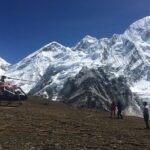
More Tours in Kathmandu

More Tour Reviews in Kathmandu
Not for you? Here's more nearby things to do in Kathmandu we have reviewed


Helicopter Tours, compared.
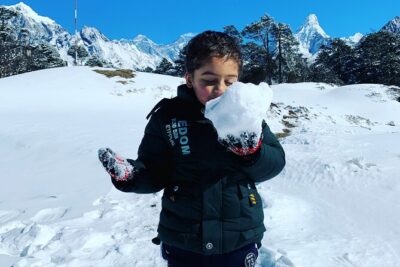 ★ 5.0Everest Base Camp Helicopter Tour landing at Everest View HotelFrom $1,575668 reviews
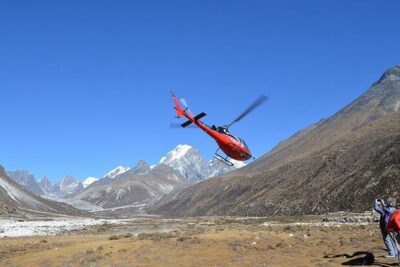 ★ 5.0Everest Base Camp Helicopter Tour landing at Hotel Everest ViewFrom $1,600218 reviews
 ★ 5.0Everest Base Camp Trek with Helicopter Return from Gorakshep to LuklaFrom $3,000161 reviews
 ★ 5.0Everest Base Camp helicopter tour with landingFrom $1,60061 reviews
 ★ 5.0Everest Base Camp Helicopter Tour with Hotel Everest View LandingFrom $1,49052 reviews
 ★ 5.0Guaranteed Landing at Everest Base Camp Kalapathar by HelicopterFrom $3,50038 reviews
★ 5.0Everest Base Camp Helicopter Tour landing at Everest View Hotel.From $1,98534 reviews
★ 5.0Guaranteed Landing at Everest Base Camp Kalapathar by HelicopterFrom $3,50038 reviews
★ 5.0Everest Base Camp Helicopter Tour landing at Everest View Hotel.From $1,98534 reviews
 ★ 5.0Everest Base Camp Trek with Helicopter Return to Lukla – 10 DaysFrom $79934 reviews
Browse the lists this tour appears in